Google
★★★★★
5-STAR RATED PAVER RESTORATION.
Small paver repairs are evaluated as part of the whole surface so resetting, cleaning, joint work, and sealing happen in the right order.
Read customer reviews →
Selected small paver repairs in Northeast Florida
Sunken. Loose. Rocking. Uneven. Correct the small problem before the restoration is finished.
Small paver repairs are evaluated as part of the whole surface so resetting, cleaning, joint work, and sealing happen in the right order.
Read customer reviews →Selected localized low spots evaluated for lifting and resetting.
Individual unstable units assessed for bedding, joint, or edge issues.
Localized corrections tied to restoration—not full hardscape reconstruction.
Agreed resets are completed before final joint restoration and protection.
When a few pavers are low, rocking, loose, or out of alignment, those conditions should be evaluated before the surface is cleaned, resanded, and sealed. HydroSeal handles selected small paver repairs and re-leveling associated with restoration projects in Jacksonville, St. Johns County, and nearby service areas.
Paver repair ranges from resetting one loose unit to reconstructing an entire failed driveway. Those are not the same service. HydroSeal focuses on the smaller end: localized areas where individual pavers or a limited section can be lifted, the bedding corrected where appropriate, and the pavers reset into better alignment.
This is especially useful when a driveway, walkway, patio, or pool deck is otherwise a good candidate for cleaning and sealing but has a few obvious low or unstable areas that should not be ignored.
Large structural failures, widespread settlement, major drainage reconstruction, extensive root heave, retaining-wall movement, or full new installations are outside this restoration-focused scope.
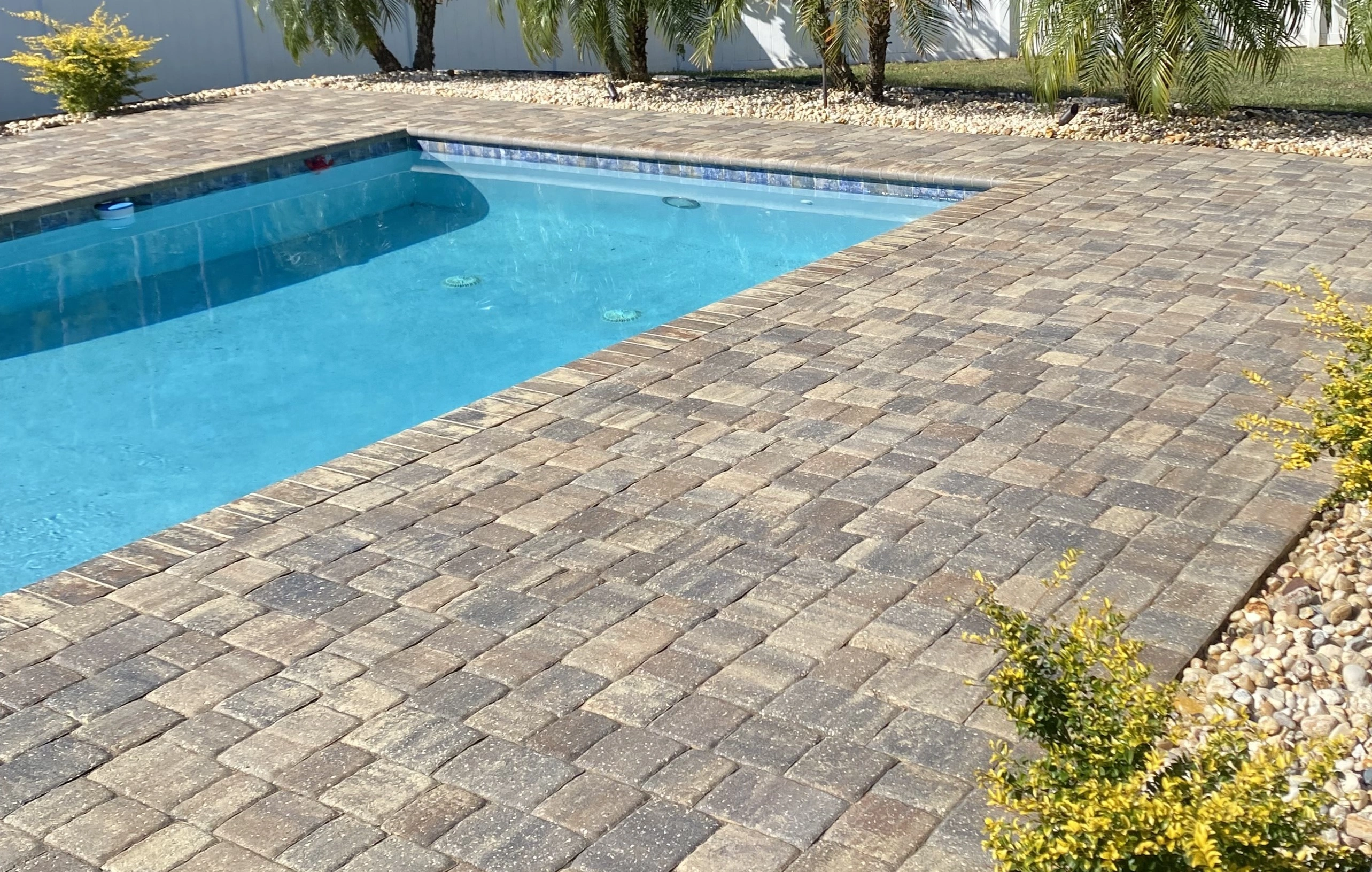
A small depression may be caused by localized bedding loss, settlement, erosion, or loading. When the underlying condition is suitable, pavers can be lifted and reset to improve grade and alignment.
Movement can come from low joint material, edge movement, bedding problems, localized washout, or disturbance. The likely cause matters before deciding whether a simple reset will hold.
Small height differences near walkways, driveways, pool-deck edges, drains, coping, or adjoining surfaces can sometimes be improved with localized re-leveling.
A cracked or damaged unit may be replaceable when a matching paver is available and the surrounding base is stable enough for a localized repair.
Selected edge areas may be reset when movement is limited. Missing restraint, active erosion, or widespread edge failure can require a hardscape contractor rather than a cosmetic reset.
Localized pool-deck issues are evaluated carefully around coping, drains, screen-enclosure anchors, wet walking areas, and transitions where abrupt height changes matter.
Pavers are flexible pavement. Their strength depends on the base, bedding layer, edge restraint, joint system, and drainage working together. A localized low spot may come from settlement or bedding loss, but it can also be a symptom of water moving material underneath the surface.
Irrigation leaks, roof runoff, poor drainage, erosion at an edge, repeated vehicle loading, or a poorly compacted area can all contribute to movement. If an active cause is still present, simply raising the pavers may only provide a temporary visual correction.
Tree roots can lift or displace pavers, while widespread heaving can indicate a much larger base or site condition. Cutting or grinding major roots can affect the tree and is not automatically part of a paver repair.
When movement is broad, deep, recurring, or tied to drainage or structural conditions, the better recommendation may be a dedicated hardscape, drainage, or tree professional before any sealing work is scheduled.
Vehicle loading makes grade, support, and transition especially important. Repeated sinking in a tire path can point to more than a surface-level bedding issue, so recurring or widespread depressions need careful evaluation.
Pool decks require attention around coping, drains, screened enclosures, water flow, and bare-foot walking areas. Repairs should avoid creating abrupt lips or new places for water to collect.
Smaller pedestrian areas can develop localized settlement near downspouts, landscaping, edges, gates, or transitions. Access and the likely source of movement help determine whether a reset is practical.
Sealer protects and enhances the surface; it does not make a low paver level, stop an active washout, or repair a failed base. If a few pavers need resetting, completing that work first keeps the finished sealing project from being disturbed immediately afterward.
Once agreed repairs are complete, the restoration sequence can move to professional cleaning, joint evaluation, and sealing. This produces a more logical finished system than trying to repair individual pavers after the surface has already been cleaned, resanded, and sealed.
A small reset is not the right answer for every uneven surface. HydroSeal will not present localized leveling as a substitute for major reconstruction.
Large areas that continue sinking, rutting, or moving can require excavation, base rebuilding, compaction, and drainage correction beyond a restoration service.
Standing water, active washout, broken drains, or runoff that repeatedly removes material should be corrected at the source before a cosmetic paver reset.
Major tree-root heave, retaining-wall movement, extensive coping problems, or large-scale replacement can require specialized contractors before cleaning and sealing make sense.
HydroSeal specializes in paver restoration. We handle selected small resets and re-leveling that fit naturally with cleaning and sealing projects. When the failure is larger than that scope, we would rather identify it than hide it under a finished coating.
The fastest way to evaluate a small repair is usually with clear photos: one close view of the affected pavers, one wider view showing the surrounding grade, and photos of any nearby drain, edge, coping, root, or washout. That helps determine whether the issue appears to fit our localized repair scope before a service date is discussed.
We handle selected localized areas of sunken or uneven pavers associated with restoration and sealing projects. When the underlying condition is suitable, affected pavers can be lifted, the bedding corrected, and the units reset.
Often, yes. The cause can be low joint material, bedding movement, edge movement, washout, or localized settlement. We evaluate the condition first so the repair matches the problem.
Generally, yes. Agreed resets and leveling should be completed before final cleaning, joint restoration, and sealer application so the finished surface does not have to be disturbed afterward.
Potentially, if the surrounding installation is stable and a suitable matching replacement paver is available. Color and batch differences can make exact matching difficult on older installations.
No. HydroSeal focuses on selected small paver repairs associated with restoration. Widespread base failure, major excavation, large drainage reconstruction, extensive root heave, and full installations are better suited to a dedicated hardscape contractor.
Recurring settlement can point to washout, drainage, irrigation leaks, poor compaction, loading, or a deeper base issue. If the underlying cause remains active, simply raising the pavers may not be a durable fix.
Send clear photos of the affected area and the surrounding surface. We will tell you whether it appears to fit HydroSeal’s small paver-repair and re-leveling scope.