Travertine Decision Guide
Should You Seal Travertine Pool Decks in Florida?
Travertine often benefits from breathable, stone-compatible protection, but the wrong film, finish, or application can darken the stone, trap moisture, or reduce wet traction.
Quick answer
Many Florida travertine pool decks should be sealed, but usually with a breathable penetrating or enhancing product rather than a heavy glossy film. The correct choice depends on absorption, filler, moisture, salt exposure, traction, and desired appearance.
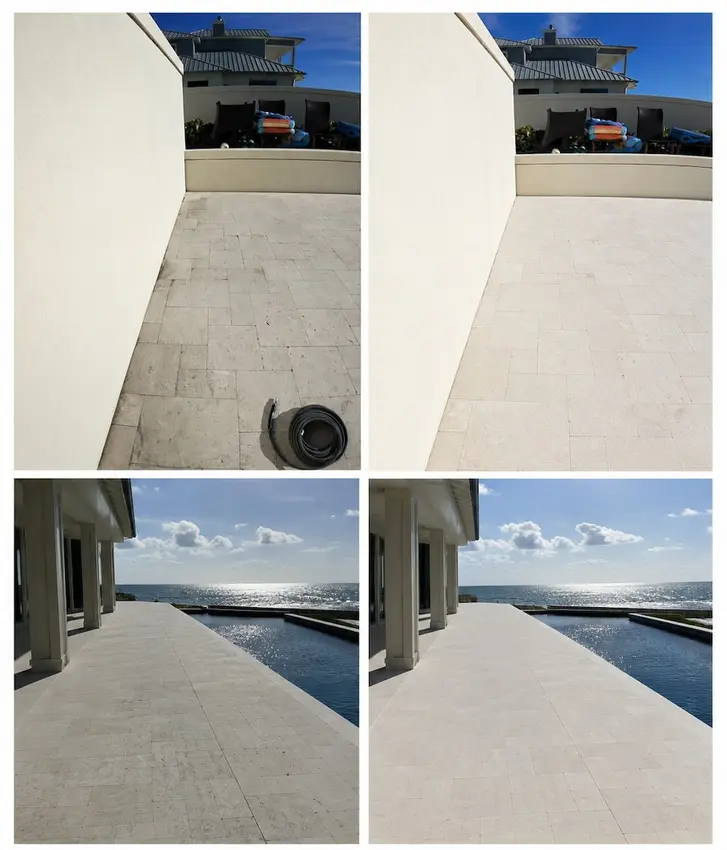
When sealing travertine helps
- Reduces absorption of water, sunscreen, oils, and tannins.
- Provides more cleanup time before stains penetrate deeply.
- Can reduce water and salt intrusion in coastal conditions.
- May make routine cleaning easier.
- Can enhance color when that appearance is desired.
Penetrating vs. film-forming travertine sealer
| Type | Appearance | Main advantage | Main caution |
|---|---|---|---|
| Natural-look penetrating | Minimal change | Breathability and preserved texture | Less dramatic color enhancement |
| Enhancing penetrating | Deeper, richer color | Protection without heavy film | May darken repairs and filler unevenly |
| Film-forming coating | Visible sheen or gloss | Strong surface appearance | Greater moisture, buildup, and traction risk |
7 reasons some travertine should not be sealed yet
- Active efflorescence or mineral residue
- Persistent moisture or poor drainage
- Unknown old coating
- Peeling, whitening, or heavy film buildup
- Unrepaired cracks, loose filler, or unstable stone
- Surface contamination from oils, metals, or chemicals
- No test area for color and traction
Florida and coastal conditions
Travertine around pools in Ponte Vedra, Nocatee, Palm Valley, and Jacksonville Beach can face salt, irrigation, humidity, shade, sunscreen, and frequent wetting. These conditions favor breathable protection and careful cure timing.
HydroSeal product example
HydroSeal uses Trident Break Wall in appropriate natural-stone applications when breathability, water and salt resistance, and minimal visible change are priorities. This is an example of a product HydroSeal uses, not a universal recommendation. Suitability requires inspection.
Common questions
Should travertine pool decks be sealed in Florida?
Often yes, when a breathable stone-compatible product can reduce absorption and staining without creating excessive film or traction problems. The stone and site conditions should be evaluated first.
Will sealing travertine make it slippery?
A penetrating product usually changes surface texture less than a film-forming coating, but wet traction should still be evaluated. No sealed surface should be described as slip-proof.
Does travertine sealer change the color?
Natural-look penetrating products minimize visible change, while enhancing products intentionally deepen color. A test area is recommended.
Need a travertine evaluation?
Send HydroSeal photos of the stone, drainage, and any known coating history. Product suitability and restoration feasibility require inspection.