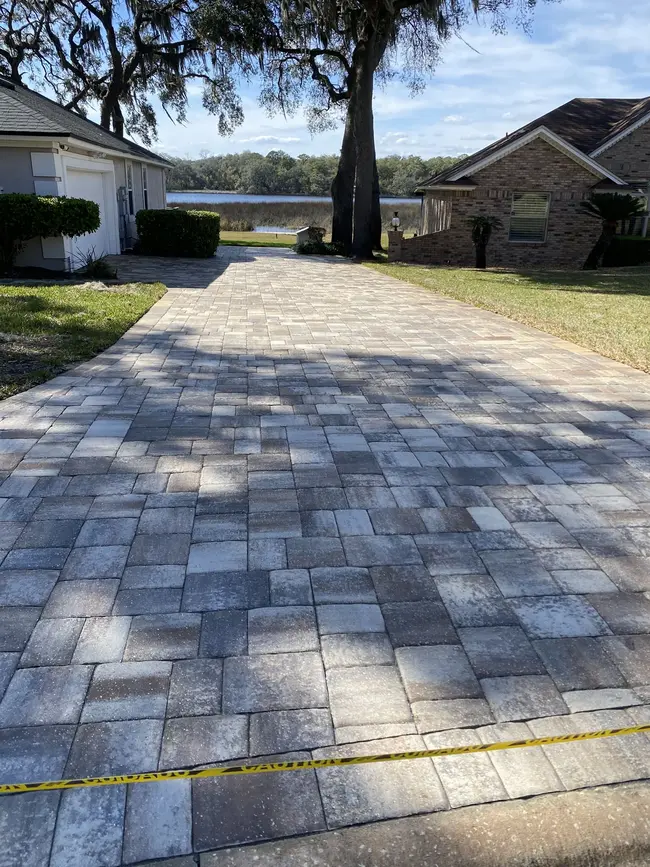
Pearl
Best for light travertine and pale pavers that need a clean, low-contrast finish.
In Orange Park, paver driveways and patios deal with a familiar mix: heavy rain, irrigation overspray, and shaded areas that stay damp longer than homeowners expect. On many properties, driveways also have a gentle slope toward the street, which can move joint sand over time and create uneven wear patterns.
Long-term results come from doing the “boring” parts correctly: deep cleaning with the right chemistry, restoring the joints, verifying dry time, then applying sealer in controlled coats to avoid haze, tacky spots, and blotchy color.
A good sealing job isn’t a “shine job.” It’s protection + uniformity + joints that hold up after rain and irrigation— without puddling, blotches, or tacky areas.
Prep, joint integrity, moisture control, and a repeatable system — that’s what makes results last.
We check drainage, stains, joints, and movement so expectations are clear.
We clean for adhesion and uniform results — not just appearance.
We reset joints with Trident joint sand and compact for stability.
If the surface isn’t dry enough — or the window isn’t safe — we pause.
Controlled coverage for a clean finish — no puddles, streaks, or tacky spots.
We confirm coverage, review cure time, and give clear care guidance.
We check drainage, stains, joints, and movement so expectations are clear.
We clean for adhesion and uniform results — not just appearance.
We reset joints with Trident joint sand and compact for stability.
If the surface isn’t dry enough — or the window isn’t safe — we pause.
Controlled coverage for a clean finish — no puddles, streaks, or tacky spots.
We confirm coverage, review cure time, and give clear care guidance.
Paver sealing prices in Orange Park vary based on square footage, paver porosity, surface and joint condition, joint sand loss, staining, access, drainage patterns, and overall preparation requirements. Proper preparation and joint integrity are critical for long-term performance in Florida conditions, especially with frequent rain and irrigation.
Most professional projects start around $1.50 per square foot. We use Trident Hurricane CAT 5 sealer and Trident joint sand (ASTM-C144)—contractor-grade materials designed to hold up better than homeowner or budget products. Final pricing depends on surface condition, joint stability, access, and the amount of prep required to achieve a clean, consistent finish that lasts.
Joint washout usually comes from low or poorly compacted sand, runoff across sloped surfaces, and regular irrigation overspray. In Orange Park neighborhoods with mature landscaping and frequent sprinkler use, damp joints can also attract organics that break down sand faster. Restoring joints and compacting correctly before sealing helps reduce washout and keeps pavers more stable.
Most homeowners reseal about every 2–3 years. Driveways with daily parking and direct sun usually wear faster than shaded patios. Recoating before the sealer wears completely through helps maintain a more uniform finish and reduces heavy prep later.
If the joints are low or unstable, yes. We remove deteriorated joint material and re-sand using Trident joint sand (ASTM-C144), compacted to the correct depth. Skipping joint restoration is one of the main reasons pavers shift and weeds return after heavy rain.
Most haze and blotch issues come from moisture or over-application. Sealing damp pavers, trapping moisture in shaded areas, or applying too heavy of a coat can create a cloudy or uneven finish. Florida humidity and pop-up rain make moisture control critical, which is why we verify dry conditions before sealing.
With proper preparation and professional-grade materials, most sealed paver surfaces typically last about 3–4 years in Florida conditions. Longevity depends on traffic, sun exposure, irrigation, drainage, and routine maintenance. Recoating before full wear-through usually extends results.
Spring through early fall can work well as long as the surface is fully dry and the forecast allows proper cure time. In Orange Park, shaded areas and frequent irrigation can keep pavers damp longer than expected, so we schedule sealing around moisture conditions—not just the calendar.