Florida Travertine Decision Guide
Does Travertine Need to Be Sealed in Florida?
Travertine is naturally porous, but “porous” does not mean every surface should receive the same sealer. Location, moisture, finish, filler, old coatings, traction and appearance goals all matter.
Quick answer
Many Florida travertine surfaces benefit from breathable, stone-compatible sealing, but the surface should be evaluated first. Outdoor pool decks, patios, walkways and entries face different moisture, stain and traction conditions than interior stone.
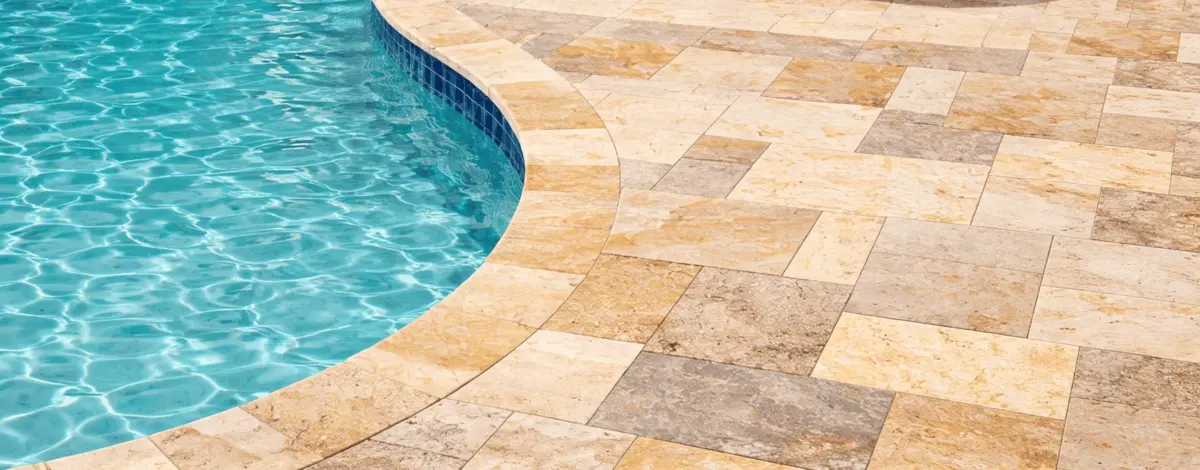
When sealing travertine is usually helpful
- Outdoor stone is exposed to frequent water or irrigation.
- Sunscreen, oils, food, leaves or tannins create stain risk.
- The stone absorbs water readily.
- Coastal salt or pool exposure is significant.
- The homeowner wants easier routine cleanup.
- A compatible penetrating product can protect without creating excessive film.
Travertine sealing decision chart
| Condition | Seal now? | Reason |
|---|---|---|
| Clean, dry, porous outdoor stone | Often appropriate | Can reduce absorption and staining |
| Active efflorescence / mineral deposits | Not yet | Diagnose moisture and deposits first |
| Unknown old coating | Test first | Compatibility and film history matter |
| Loose filler / unstable stone | Repair first | Sealer does not correct structural defects |
| Persistent wetness / poor drainage | Evaluate first | Moisture can create coating problems |
Penetrating vs. film-forming products
| Type | Appearance | Best characteristic | Main caution |
|---|---|---|---|
| Natural-look penetrating | Minimal change | Breathability and preserved texture | Less visual enhancement |
| Enhancing penetrating | Richer / darker | Color enhancement without heavy film | Stone and filler may darken unevenly |
| Film-forming coating | Visible sheen | Strong visual finish | Greater moisture, buildup and traction risk |
Pool decks are a special case
Pool decks combine bare feet, frequent wetting, sunscreen, pool chemicals, shade and traction concerns. See the more specific guide: Should You Seal Travertine Pool Decks in Florida?
7 things to check before sealing
- Stone type and finish
- Filler condition
- Moisture and drainage
- Efflorescence or minerals
- Old sealer or coating history
- Wet-traction requirements
- Desired color and sheen
What sealing does—and does not—do
| Can help | Does not guarantee |
|---|---|
| Reduce absorption | Permanent stain prevention |
| Provide more cleanup time | Elimination of algae or mildew |
| Support easier maintenance | Correction of drainage problems |
| Enhance color when selected | Slip-proof wet performance |
Common questions
Does travertine need to be sealed?
Often, especially outdoors, but product and timing depend on surface and moisture conditions.
Should outdoor travertine always be sealed?
No. Active moisture, deposits, unstable stone or unknown coatings should be addressed first.
Does sealer make travertine darker?
It depends on the product. Natural-look products minimize visible change; enhancing products intentionally deepen color.
Need a travertine evaluation?
See Travertine Sealing Jacksonville & St. Johns County, then Get My Quote.
Get a travertine sealing quote
Send HydroSeal photos of the stone, drainage and any known coating history.