Quick answer
Efflorescence requires three things: soluble salts, moving moisture, and evaporation. Remove any one of those conditions and formation slows. Treatment can remove current deposits, but it cannot guarantee they will never return while moisture continues moving through masonry.
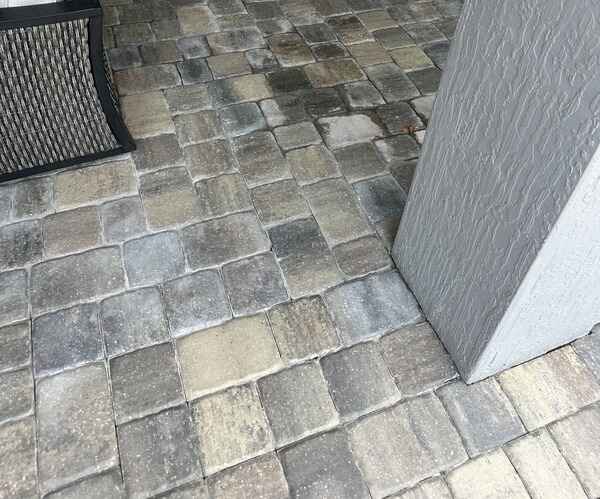
6 common causes of paver efflorescence
- Salts within new concrete pavers migrate during early wet-dry cycles.
- Bedding sand, base material, mortar, or concrete can contain soluble minerals.
- Rain and irrigation repeatedly move water through the system.
- Poor drainage or low areas keep pavers wet longer.
- Ground moisture and high water tables move vapor and salts upward.
- Walls, coping, steps, and adjacent concrete can feed mineral-rich runoff onto pavers.
Efflorescence vs. sealer haze
| Clue | Efflorescence | Sealer haze or failure |
|---|---|---|
| Texture | Powdery, chalky, crystalline, or crusted | Milky film, cloudy patch, flakes, or lifted coating |
| Location | Low areas, wall bases, irrigation paths, joints | Coated areas, pooled sealer, shaded moisture zones |
| Dry brushing | May reduce loose deposit | Usually does not remove a coating defect |
| Recurrence | Can return with continued moisture movement | Returns if failed film or moisture condition remains |
| Treatment | Mineral-deposit treatment suited to the surface | Coating assessment, reworking, or removal |
Where efflorescence commonly appears in Northeast Florida
- At the bottom of sloped driveways
- Along retaining walls, columns, steps, and coping
- Near sprinklers and repeated irrigation runoff
- In shaded pool-deck sections that dry slowly
- Around downspouts, roof runoff, and low drainage areas
- On new pavers during early moisture cycles
Jacksonville, Nocatee, Ponte Vedra, Palm Valley, and coastal communities experience frequent rainfall, irrigation, humidity, and wet-dry cycling that support mineral migration.
Treatment options and limits
| Condition | Likely approach | Limit |
|---|---|---|
| Loose new-paver powder | Dry removal or mild surface-appropriate cleaning | May reappear during later moisture cycles |
| Bonded mineral crust | Designed efflorescence treatment, agitation, and rinsing | Multiple treatments may be needed |
| Deposits beneath sealer | Evaluate coating removal before mineral treatment | Sealer may block access to the deposit |
| Recurring low-area deposits | Treat residue and address water movement | Cleaning alone does not correct drainage |
What not to do
- Do not assume every white mark is efflorescence.
- Do not seal over visible deposits.
- Do not use acids without testing surface and coating compatibility.
- Do not promise permanent non-recurrence.
- Do not ignore drainage, irrigation, or moisture sources.
Common questions
Will pressure washing remove efflorescence from pavers?
Pressure washing may remove loose powder but often does not dissolve bonded mineral deposits. A surface-appropriate treatment and thorough rinsing may be required.
Can efflorescence return after pavers are sealed?
Yes. Sealing may reduce water entry from above, but it cannot eliminate every source of moisture or salt movement from below and around the pavers.
Is efflorescence a paver-sealer failure?
Not automatically. Efflorescence is mineral residue caused by moisture carrying salts to the surface. Sealer haze is a separate coating condition, although both may occur together.
HydroSeal field guidance
HydroSeal provides condition-based evaluation for selected properties across Jacksonville, Nocatee, Ponte Vedra, and nearby Northeast Florida communities. Treatment can improve appearance, but full removal and permanent prevention cannot always be guaranteed. For contractor service details, see Paver Efflorescence Removal in Jacksonville.