White-Sealer Troubleshooting
Why Did My Paver Sealer Turn White?
White or milky pavers may indicate trapped moisture or failed sealer, but they can also be caused by efflorescence, polymeric-sand haze, hard-water minerals, cleaning residue, or UV-degraded coating.
Direct answer
Paver sealer often turns white when moisture becomes trapped in or beneath a film, the coating blushes during cure, too much product is applied, incompatible layers react, or an older coating degrades. But not every white appearance is sealer failure. Efflorescence, polymeric-sand haze, irrigation minerals, and cleaner residue must be ruled out first.
Six conditions that can look white
- Trapped moisture or sealer blushing: a milky or cloudy film that may change with sun, heat, or drying.
- Efflorescence: powdery mineral salts moving through masonry as moisture evaporates.
- Polymeric-sand haze: fine binder residue left on the paver face after improper installation or activation.
- Hard-water or irrigation residue: rings, streaks, or chalky deposits following sprinkler coverage.
- Incompatible or overapplied sealer: heavy, soft, peeling, cloudy, or uneven coating layers.
- UV-degraded coating: older film that becomes chalky, faded, brittle, or patchy after prolonged exposure.
Symptom comparison
| What you see | Likely direction | Clue |
|---|---|---|
| Milky film beneath gloss | Moisture or blushing | Appearance changes with drying or heat |
| Dry powder | Efflorescence | May brush off and return after wetting |
| Uniform dusty film after sanding | Polymeric-sand haze | Appears after sand installation or activation |
| Sprinkler rings or streaks | Mineral residue | Follows irrigation pattern |
| White edges, flakes, or soft film | Coating failure | Layer lifts or separates |
| Chalky older coating | UV degradation | Widespread weathered appearance |
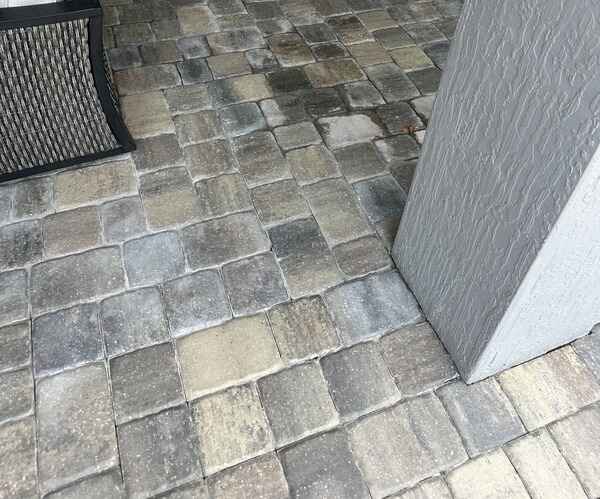
Why this is common in Northeast Florida
Jacksonville, Nocatee, Ponte Vedra, Palm Valley, and nearby communities combine heavy rain, irrigation, humidity, shade, coastal moisture, and repeated wet-dry cycles. Those conditions can move minerals, slow drying, or expose weaknesses in an existing coating.
What not to do
- Do not assume every white area is efflorescence.
- Do not apply another coat before identifying the cause.
- Do not use strong acid without confirming the surface, coating, and residue.
- Do not promise that mineral deposits can never return.
- Do not reseal until the surface is clean, dry, stable, and compatible.
Typical repair directions
Mineral residue may require controlled treatment and correction of irrigation or moisture sources. Polymeric haze may require a product-specific cleaning approach. Unstable or incompatible coating may require testing, partial removal, or full stripping. Persistent blushing should be diagnosed before any recoat is considered.
What HydroSeal does
HydroSeal evaluates the pattern, texture, coating condition, low areas, irrigation coverage, drainage, moisture history, and previous products before recommending treatment. Improvement is often possible, but complete removal and non-recurrence cannot be guaranteed without understanding the cause. When testing points to mineral deposits, see our paver efflorescence removal service. When the problem is inside a failed coating, review paver resealing and restoration.
Frequently asked questions
Why did my paver sealer turn white after rain?
Rain can expose trapped moisture, move salts, or reveal an unstable coating. The pattern must be diagnosed before treatment.
Will white sealer clear by itself?
Temporary moisture haze may improve as conditions dry. Persistent coating failure, mineral residue, or polymeric haze usually requires corrective work.
Can another coat fix it?
Usually not without compatibility testing and diagnosis. Another coat can make the problem harder to correct.
Not sure what caused the white appearance?
Send HydroSeal photos showing the full area, close-up texture, low spots, coating edges, and irrigation pattern.